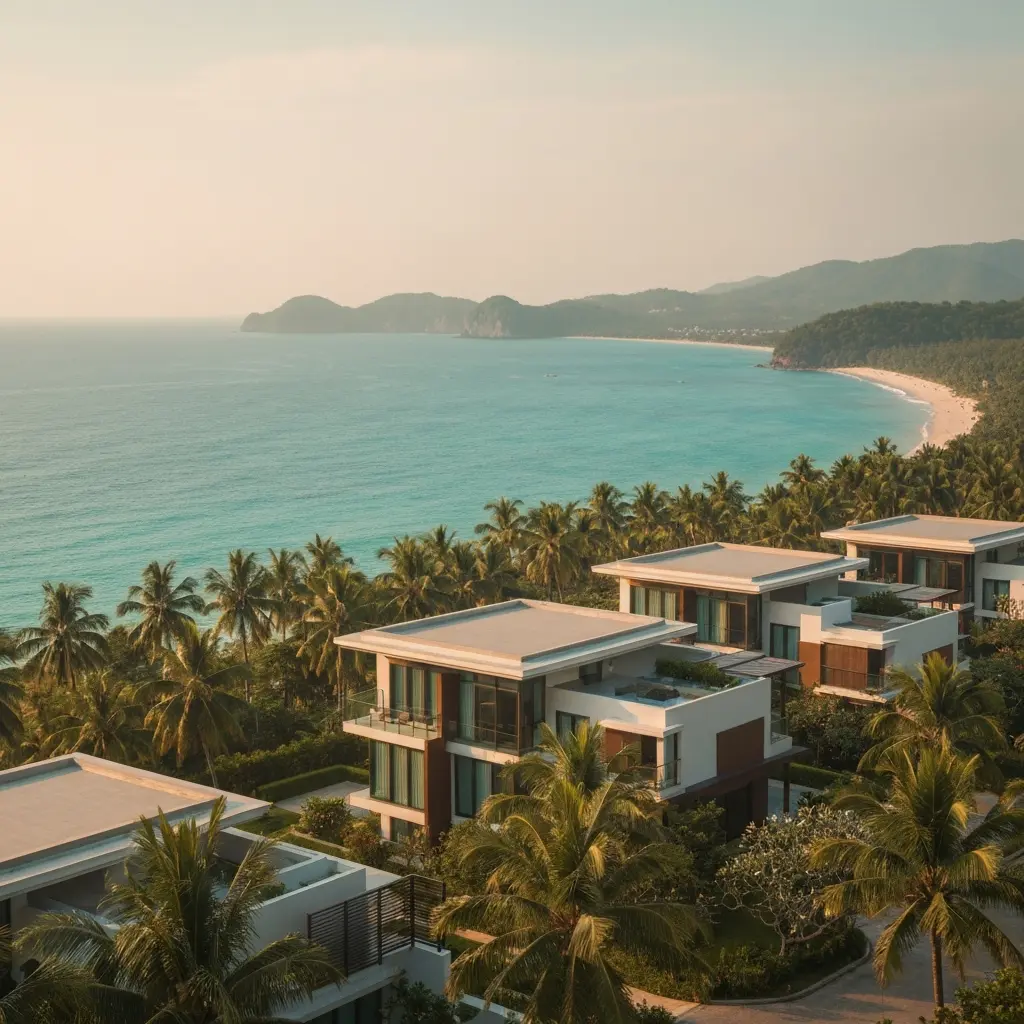
Koh Samui sells itself differently from Phuket. It is a smaller island with a lower building density, no motorway spine, and a development pattern that has stayed closer to the coastline and the hills immediately behind it. Buyers who arrive after a Phuket search usually notice the change of scale within a day: fewer large branded schemes, more individually designed hillside houses, and a shorter list of places where anything is happening at all.
That character shapes the purchase. The signature Samui product is a hillside villa with a sea view — which means landed property, which in turn means the ownership route for a foreign buyer is a registered leasehold rather than freehold. It also means the practical due diligence is different: access roads, water supply, retaining structures and drainage matter far more on a steep plot than they do in a flat coastal estate.
This page covers what is specific to Samui. The national legal framework — leasehold mechanics, the purchase path, enforcement against nominee company structures — is set out in full on our national landed-property guide and our ownership guide, both linked below. Here the focus is the island itself: how it differs, where buyers look, what the yield evidence actually supports, and what to check before signing.
How the Samui villa market differs from Phuket
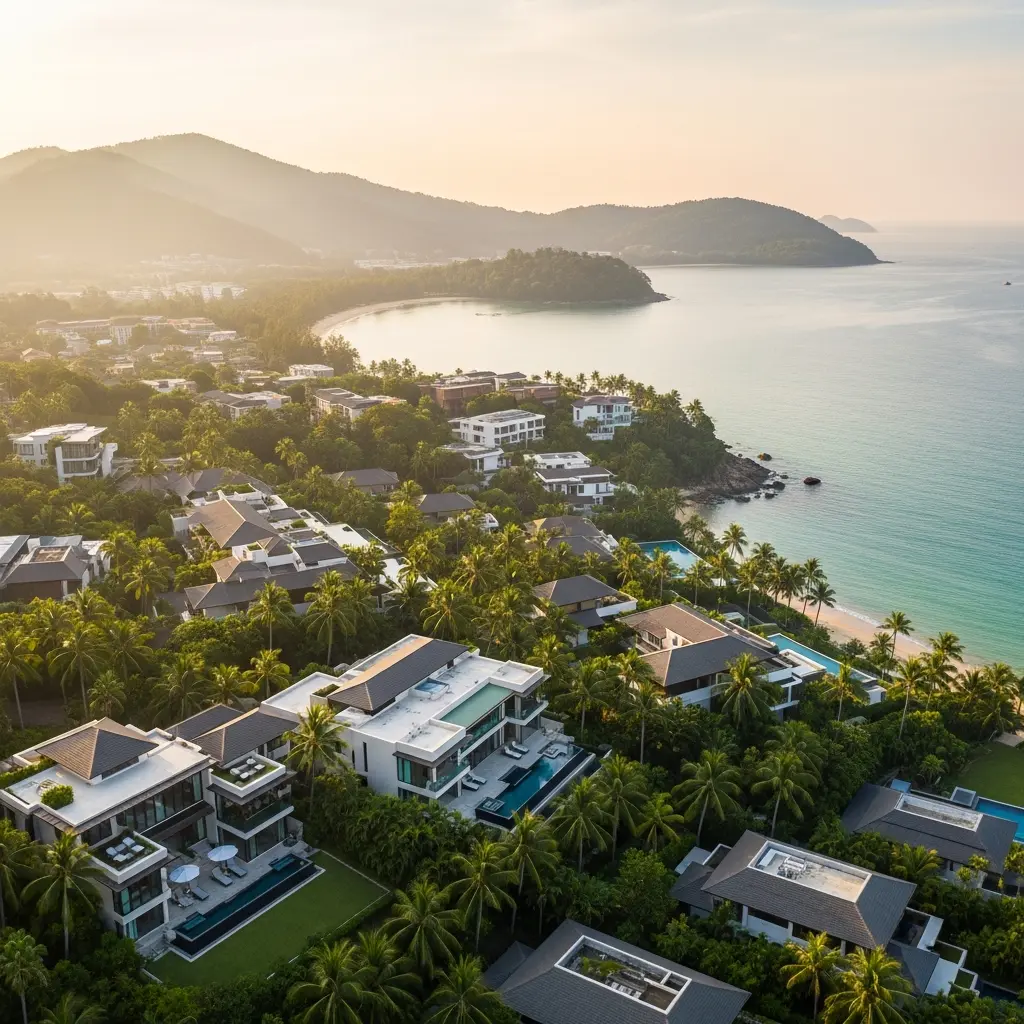
Phuket is bigger, denser, and connected to the mainland by bridge, which has allowed continuous large-scale construction along its west coast for two decades. Samui has no bridge. Everything arrives by air through Samui Airport or by ferry from Donsak and Koh Phangan, and that logistical filter has kept the pace of development slower and the scale smaller.
The practical result is a different inventory. On Samui, hillside sea-view houses are the defining product rather than one option among many. Plots tend to be individual or grouped into small estates of a handful of homes, rather than the hundred-unit branded resort-residence schemes common in parts of Phuket. Beachfront land is limited and rarely comes to market. Condominiums exist but form a much smaller share of the island's stock.
This cuts both ways. Lower density and a quieter island are the reason many buyers choose Samui, and the reason a sea view here often costs less to buy than an equivalent outlook on Phuket's west coast. But the smaller market also means fewer comparable sales to price against, thinner resale liquidity, and less published data of any kind. Across the properties this site tracks in both regions, observed asking prices run from approximately US$130,000 for entry-level condominiums to US$2,500,000 and above for luxury villas (site-tracked range, May 2026) — a spread wide enough that it tells you very little until you narrow it to a specific plot, and no substitute for local comparables.
Seasonality also differs. Samui's weather pattern is not identical to the Andaman coast, and the island's heaviest rain typically arrives later in the year than Phuket's. If rental income forms part of your case, ask any agent to show you occupancy month by month rather than as an annual average.
Next Step
Related Reading
Continue with related guides and representative listings on this topic.
Ownership in short: a villa is landed property
A villa sits on land, and foreigners cannot own land in Thailand. The lawful route for a foreign buyer of a Samui villa is therefore a registered 30-year leasehold over the land, usually paired with ownership of the building itself, registered at the local Land Office. Renewal options beyond the first 30 years are contractual promises between the parties, not statutory rights.
A Thai limited company set up to hold land on a foreigner's behalf — a nominee structure, sometimes marketed as "company freehold" — is illegal and under active enforcement following DBD Order No. 1/2026, effective 1 April 2026. If a Samui agent presents this as the way around the land rule, treat it as a reason to walk away.
We do not repeat the mechanics here because they are national, not local. The full leasehold structure, the purchase sequence and the enforcement position are set out in our guide to houses for sale in Thailand, and the statutory framework behind freehold and leasehold is covered separately. If the outcome of reading those is that you would rather hold freehold title, a condominium unit within the 49% per-building foreign quota is the route that allows it — covered on our condominium page.
The island's areas, in plain terms
Samui's geography is simple enough to hold in your head: a roughly circular island with a ring road, an active east side, a quieter north, and a west coast that faces the sunset.
Chaweng and Lamai (east). These are the island's commercial centres. Chaweng has the longest beach, the densest concentration of restaurants, bars, shops and hotels, and the most consistent visitor traffic. Lamai is the smaller, slightly more relaxed version of the same idea. Villas here are typically on the hillsides behind the beach — Chaweng Noi in particular — where elevation buys a sea view and some distance from the noise. This is where short-let demand is most obvious, and also where you will find the most competition for guests.
Bophut, Fisherman's Village, Bang Rak and Maenam (north). The north coast trades nightlife for character. Fisherman's Village in Bophut is a restored old shopfront street with a weekly market and a settled expatriate and repeat-visitor crowd. Bang Rak sits next to the airport and the pier. Maenam is longer, flatter and quieter, with hills rising behind it that hold a good share of the island's newer sea-view houses. The north generally appeals to buyers who want the island year-round rather than for peak weeks.
Lipa Noi and Taling Ngam (west). The sunset coast. Calm, shallow water, very low density, and the closest thing Samui has to genuinely wide beachfront plots. It is the furthest side from the airport and from Chaweng's services, which is precisely why buyers who want quiet choose it. Rental demand here is a narrower, more specific market — guests come for seclusion, not walkability.
Choeng Mon and Plai Laem (north-east). Small bays between Chaweng and the airport, popular with families and with buyers who want proximity to the east coast without being in it.
We deliberately do not attach price or yield figures to any of these areas. Reliable district-level published data for Samui does not exist, and any number you see broken down by area is almost always a seller's estimate rather than a measured one.
Yields on Samui: what the evidence actually supports
This is where honesty matters more than a confident number. Published villa-yield benchmarks for Koh Samui do not exist at the granularity Phuket enjoys. There is no widely cited, dated, third-party series for Samui villa net yields that we can point you to.
The nearest published reference point is the Phuket villa segment, where net returns commonly sit around 4–6% (market estimate, mid-2026; source: Kalinka Thailand, Phuket Property ROI 2026 (April 2026)). Read that as adjacent-market context only. It is a Phuket figure describing Phuket stock, in a market with more supply, more airlift and more competition. It is not a Samui number, and it should not be used as one.
What follows from that is a simple rule: treat any Samui yield claim in a listing as the seller's own figure unless it carries a named source and a date. Ask what the number is net of — management fee, agency commission, utilities, pool and garden maintenance, repairs, replacement of soft furnishings, income tax, and vacancy. Ask for the underlying booking calendar for the last two years, not a projection. Ask whether the property was let legally during that period.
Guaranteed-yield programmes deserve particular care. A guaranteed return is prepaid rent, funded by a premium built into the purchase price — typically 10–15% (AI Property Phuket, 2026). Once the guarantee period ends, returns commonly compress to roughly 3–5% net (Kalinka Thailand, 2026), and the buyer is left holding an asset bought above market. The full mechanics, including how to test whether a guarantee is funded or merely promised, are set out in our guide to guaranteed ROI versus actual rental yield.
Next Step
Related Reading
Continue with related guides and representative listings on this topic.
Letting the villa out: the hotel-licence line
The rule on Samui is the rule everywhere in Thailand. Letting a property for stays of under 30 days requires a hotel licence under the Hotel Act B.E. 2547. Without one, nightly and weekly letting is unlicensed, regardless of whether a management company handles the bookings or the listing sits on an international platform.
This matters because the Samui villa income story is almost always a nightly-rate story. If a seller or agent quotes you an average daily rate and an occupancy percentage, the first question is not "is the rate realistic" but "is this property licensed, or does it sit inside a licensed operation." Only after that question is answered does any nightly-rate discussion have meaning.
Monthly and longer lets — 30 days and above — do not require a hotel licence. They produce lower gross income but a steadier, legally cleaner profile, and on a quieter island with a substantial long-stay resident population that is a more realistic base case than many buyers expect. If a licensed short-let operation is what you want, some Samui developments are structured and licensed for it from the outset; confirm the licence exists and covers the specific building, and get the documentation rather than an assurance.
A Samui buyer's checklist
Most of this list applies anywhere in Thailand. The hillside items are where Samui differs.
Title on the underlying land. Ask for the title deed and confirm what kind it is. A Chanote (Nor Sor 4 Jor) is the fully surveyed freehold title and the one you want under a lease. Lesser documents exist and carry real restrictions. Have a lawyer pull the title history at the Land Office rather than relying on a copy provided by the seller.
The lease must be registered. A lease over three years is only enforceable against third parties once registered at the Land Office and endorsed on the deed. An unregistered agreement, however elaborate, is a contract with one party — not an interest in land.
Renewal terms in writing. Whatever renewal structure is offered, read the mechanism: who grants it, on what trigger, at what price, and what happens if the landowner sells, dies or dissolves. Only the first 30 years is statutory; the rest is drafting quality.
Access and road. On a hillside plot, confirm in writing how you reach the house. Is the access road public, or is it private land belonging to somebody else? If private, is there a registered right of way in your favour that survives a change of owner? Verbal assurances about a neighbour's driveway are the single most common problem on Samui hillsides.
Utilities. Confirm mains electricity connection and metering, and establish the water source — mains, private borehole, or delivered tanker — and who controls it. On steep plots also check retaining walls, drainage and how the site handles heavy rain. Ask to see the property after a downpour if the timing allows.
Building permits and setbacks. Samui has hillside building restrictions tied to slope and elevation. Confirm the house was permitted as built, not just built.
Funds and paperwork. Purchase money should be remitted from abroad through a Thai bank, which issues the Foreign Exchange Transaction (FET) form after the transfer arrives. Keep it. Budget for transfer costs: a 2% transfer fee, plus 0.5% stamp duty or 3.3% specific business tax where the property has been held under five years, plus withholding tax — 1% where the seller is a company, or a progressive Land Department calculation where the seller is an individual.
Independent counsel. Use a Thai property lawyer you appointed and pay directly. Not the one the agent recommends, and not the developer's.
Next Step
Related Reading
Continue with related guides and representative listings on this topic.
Frequently Asked Questions
Can a foreigner own a villa on Koh Samui outright?
Not the land. Foreigners cannot own land in Thailand, so the lawful route for a Samui villa is a registered 30-year leasehold over the plot, typically combined with ownership of the building. Only the first 30 years is statutory; any renewal beyond that is a contractual promise whose value depends entirely on how it is drafted. If freehold title is essential to you, a condominium unit within the 49% per-building foreign quota is the route that provides it.
What about buying through a Thai company so the villa is 'freehold'?
A Thai limited company formed to hold land for a foreign buyer is a nominee structure. It is illegal and under active enforcement following DBD Order No. 1/2026, effective 1 April 2026. It should not be presented to you as a compliant ownership route, and an agent who does present it that way is telling you something useful about their standards.
What rental yield should I expect from a Koh Samui villa?
There is no published, dated, third-party benchmark for Samui villa net yields at the granularity Phuket has. The nearest published reference is the Phuket villa segment at around 4–6% net (market estimate, mid-2026; source: Kalinka Thailand, Phuket Property ROI 2026 (April 2026)) — adjacent-market context, not a Samui figure. Treat any yield number in a Samui listing as the seller's own estimate unless it comes with a named source and a date, and ask what it is net of.
Do I need a licence to rent my Samui villa to holidaymakers?
Yes, if the stays are under 30 days. Letting for periods shorter than 30 days requires a hotel licence under the Hotel Act B.E. 2547, and this applies on Samui exactly as it does elsewhere in Thailand. Lets of 30 days or longer do not require the licence. Before discussing nightly rates or occupancy with any seller, establish whether the property is licensed or sits within a licensed operation.
How does Koh Samui compare with Phuket for a villa buyer?
Samui is smaller, less densely developed, and reached only by air or ferry, which has kept construction at a slower pace and a smaller scale. Hillside sea-view houses are the signature product rather than one option among many, and a comparable view often costs less than on Phuket's west coast. The trade-offs are thinner resale liquidity, fewer comparable sales to price against, and far less published market data of any kind.
What should I check specifically on a hillside plot?
Access first: confirm whether the road to the house is public or private land, and if private, whether a registered right of way exists in your favour that survives a change of ownership. Then utilities — mains electricity, and whether water is mains, borehole or delivered, and who controls the supply. Then the physical site: retaining walls, drainage and how the slope behaves in heavy rain. Finally, confirm the house was permitted as built under Samui's hillside building restrictions, not simply constructed.